The Credible Story Trending stories that keep you hooked
Related Articles


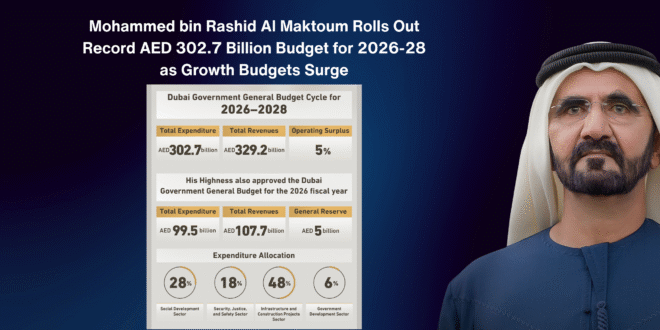
Mohammed bin Rashid Al Maktoum, Vice-President, Prime Minister of the UAE and Ruler of Dubai, has approved the largest general budget cycle in the emirate’s history. The multi-year plan covers FY 2026 to FY 2028 for the Government of Dubai, setting total expenditures at AED 302.7 billion and projected revenues at AED 329.2 billion.
In parallel, the budget for the year 2026 alone has also been ratified:
- Expenditure: AED 99.5 billion
- Revenues: AED 107.7 billion
- A general reserve of AED 5 billion has been earmarked.
Strategic Priorities & Allocation Focus
According to published breakdowns, the 2026 budget earmarks funds among key sectors:
- Infrastructure & construction projects: ~48 % of the 2026 budget.
- Social development / community sector: ~28 %.
- Security, justice & safety: ~18 %.
- Government development (digital-government, services modernization): ~6 %.
In framing the budget announcement, Dubai officials highlighted that this cycle aims to accelerate the emirate’s strategic goals under the Dubai Economic Agenda D33 — which seeks to double Dubai’s GDP and position it among the Top-3 global economic cities by 2033.
Implications & Outlook
- Growth confidence: A planned surplus (~5 % of revenues over expenditures) across the three-year cycle signals confidence in economic growth and non-oil revenue generation.
- Infrastructure-led push: Nearly half of the 2026 allocation going into infrastructure underscores Dubai’s intent to maintain competitiveness in transport, logistics, real-estate, tourism and smart-city sectors.
- Balanced social development: With more than a quarter of the budget directed at social/community sectors, the government signals sustained investment in health, education and quality of life — complementing the growth agenda.
- Fiscal stability: By setting a clear three-year budget horizon, the government offers greater predictability for investors, projects and public-sector planning.
- Investor signal: For residents and businesses (local and international), the record budget underscores Dubai’s stabilised trajectory and the willingness to scale public spending and infrastructure investment.
What to Watch
- How actual spending tracks versus the 2026 allocation across sectors like infrastructure, security and community development.
- Whether revenues keep pace with targets (AED 107.7 billion) given evolving global conditions.
- How private-sector participation (PPP projects, foreign investment) is activated by the infrastructure-heavy focus.
- Impacts on real-estate, hospitality, logistics and fintech sectors which are core to Dubai’s growth strategy.
- Monitoring the 2027-28 years of the cycle to see whether the budget scale rises further or stabilises.
Key Facts at a Glance
| Metric | Value |
|---|---|
| Total 2026-28 Expenditure | AED 302.7 billion |
| Total 2026-28 Revenues | AED 329.2 billion |
| Budget 2026 Expenditure | AED 99.5 billion |
| Budget 2026 Revenues | AED 107.7 billion |
| General Reserve | AED 5 billion |
This landmark budget not only cements Dubai’s momentum but also sets the stage for the next phase of its transformation. With robust spending and revenue plans aligned to strategic visions, the emirate appears poised for growth — as long as execution and global conditions support the targets.